

 By
By Finance Minister Nirmala Sitharaman rolled out the Union Budget for 2026-27 on February 1st, and it’s clearly a major move toward hitting the ‘Viksit Bharat’ goal by 2047. With the global economy being a bit unpredictable, the budget impressively juggles big-time spending on infrastructure (capital expenditure) with keeping the nation’s finances in check. This budget is characterized by its strategic prudence, focusing on long-term structural reforms over short-term populist measures, cementing India’s trajectory as one of the fastest-growing major economies.
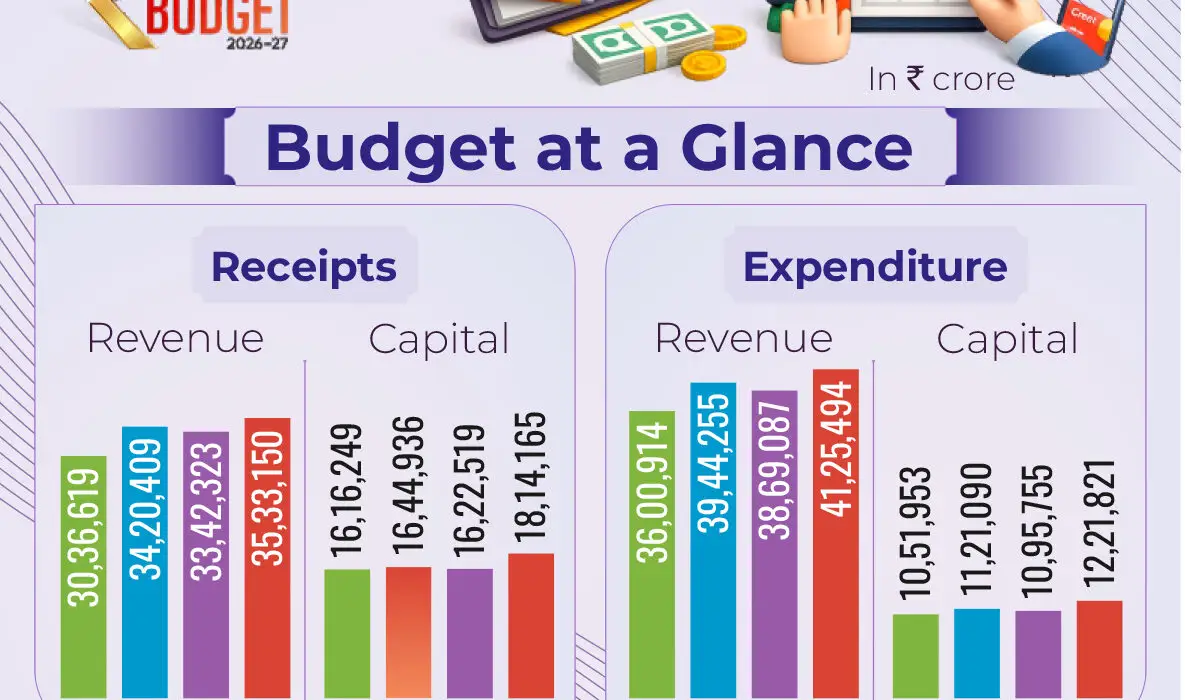
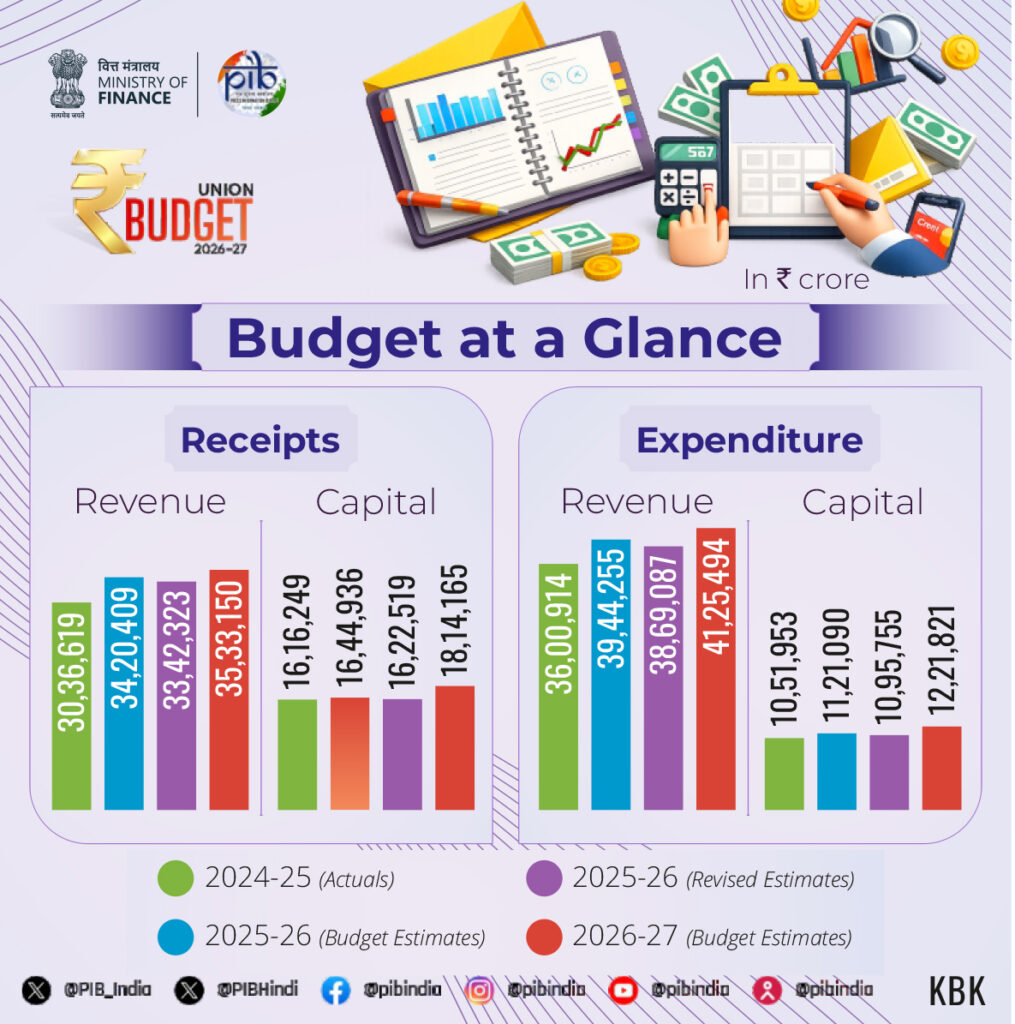
With a massive planned spend of ₹53,47,315 crore, the whole plan is built on three main commitments (or Kartavyas): boosting the economy, building up people’s skills, and making sure everyone benefits. The underlying philosophy is that sustained, high-quality public investment, especially in infrastructure and human capital, will crowd in private investment, creating a virtuous cycle of growth.
1. Keeping the Economy Steady and the Finances Tight: The Prudence Principle
The government is sticking to a smart, non-populist plan, focusing on realistic money management and disciplined fiscal consolidation. The 2026-27 budget is a critical step in de-risking the Indian economy from global shocks by managing debt and deficit levels proactively.
Fiscal Consolidation and Macroeconomic Stability
The Finance Minister reiterated the commitment to a defined fiscal glide path, a signal of serious intent to global investors and rating agencies.
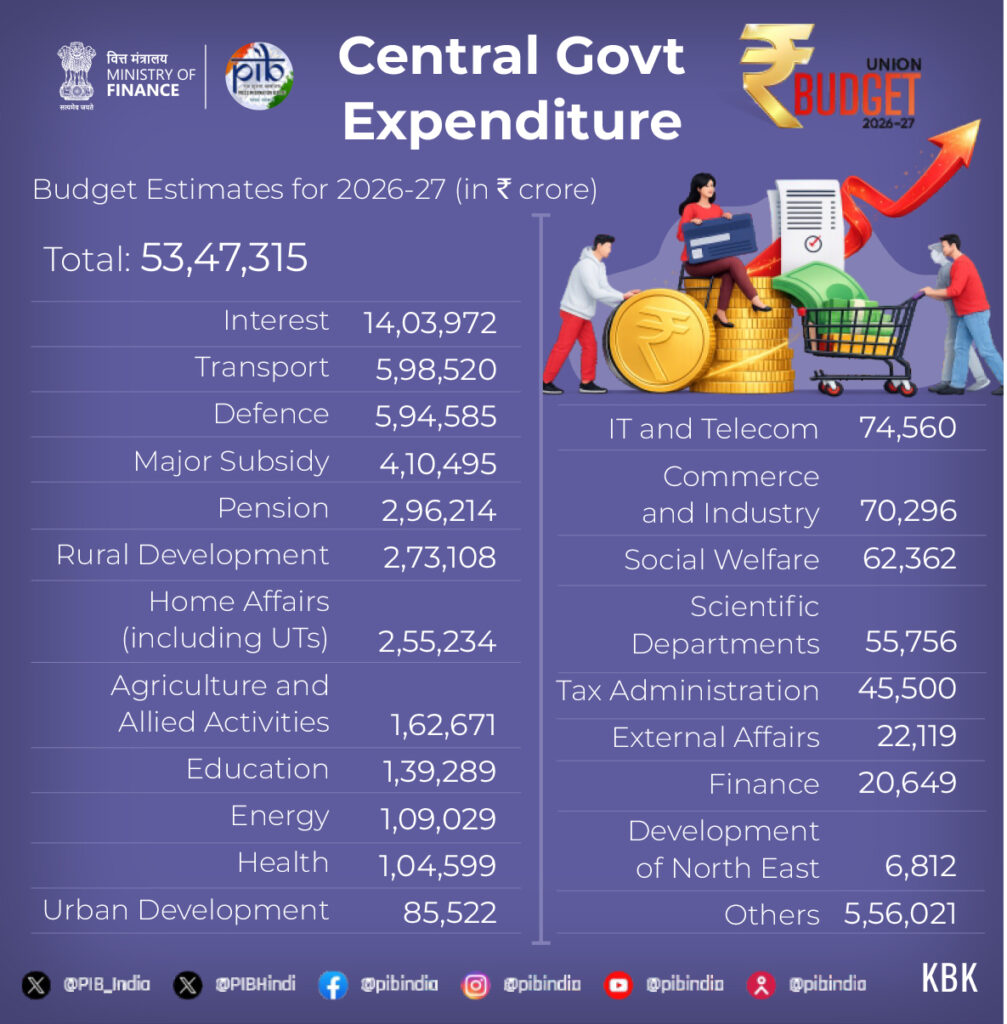
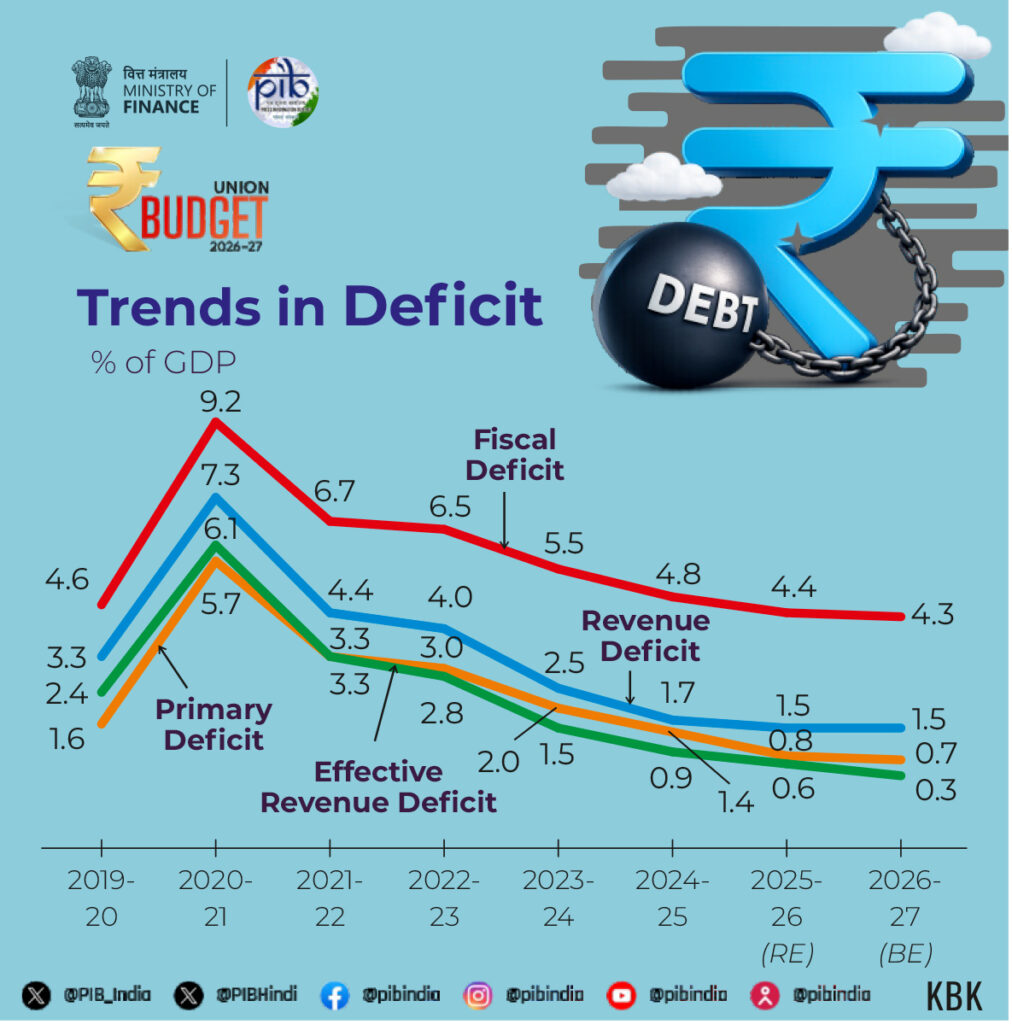
- Fiscal Deficit: They’re aiming for a tight 4.3% of GDP for FY27, down from the previous 4.4% revised estimate. This achievement is significant, especially considering the continued high allocation to capital expenditure. It reflects improved tax buoyancy and more efficient public expenditure management. The path to achieving the targeted 4.3% hinges on a projected 11.5% growth in gross tax revenues and a disciplined approach to non-essential revenue expenditure.
- GDP Growth: They’re projecting a 10% nominal GDP growth for 2026-27. This projection is considered pragmatic, balancing global headwinds with the domestic growth drivers unleashed by the government’s infrastructure push. Real GDP growth is expected to hover around 7.2-7.5%.
- Debt Reduction: The target is to get the Debt-to-GDP ratio down to 55.6% in FY27, with a longer-term dream of hitting 50% by 2030-31. This focus on debt management is crucial for inter-generational equity and maintaining macro-stability. The budget outlines plans to utilize proceeds from a renewed push on non-core asset monetization and disinvestment to actively reduce market borrowings.
Capital Expenditure: The Engine of Growth
This budget solidifies the government’s strategy of using capital expenditure (Capex) as the primary tool for economic stimulus.
- Capex Allocation: This is getting a huge jump to ₹12.2 lakh crore (an 8% bump), showing they really believe in its power to kickstart growth. This sustained double-digit Capex growth over the last three years marks a structural shift away from consumption-led growth toward investment-led growth. This massive spending is directed towards core infrastructure like railways, roads, power, and digital infrastructure, which have high multiplier effects across the economy.
| Fiscal Indicator | FY26 (Revised Estimate) | FY27 (Budget Estimate) | Target % of GDP (FY27) |
|---|---|---|---|
| Total Expenditure | ₹49,50,000 crore | ₹53,47,315 crore | N/A |
| Capital Expenditure | ₹11,30,000 crore | ₹12,20,000 crore | ~3.3% |
| Fiscal Deficit | 4.4% | 4.3% | 4.3% |
| Nominal GDP Growth | 9.0% | 10.0% | N/A |
source:https://www.pib.gov.in/
2. Infrastructure and Connectivity: The Pillars of Viksit Bharat
The infrastructure push under the PM Gati Shakti National Master Plan receives the largest share of the capital budget, demonstrating a commitment to creating world-class physical and digital connectivity that reduces logistics costs and enhances India’s global competitiveness.
Key Transport & Connectivity Wins
The investment is diversified across all modes of transport to create a truly multi-modal logistics network.
- Railways: Got its biggest-ever funding at ₹2.78 lakh crore. This allocation is primarily focused on capacity expansion, safety, and modernization.
- New Rail Lines: Get ready for seven new high-speed rail lines (including the expansion of the bullet train project to new corridors) and dedicated freight corridors, like the one connecting Dankuni (West Bengal) to Surat (Gujarat). This specific corridor will decongest the existing mixed-traffic lines and drastically cut the time taken to move goods between key industrial clusters in the East and West.
- Vande Bharat: The plan includes manufacturing and deploying 400 more Vande Bharat trains, focusing on non-AC sleeper versions for long-distance travel.
- Highways: The Road Transport Ministry has ₹3.09 lakh crore to play with.
- Growth Connectors: Focus is on key “Growth Connectors,” which are high-speed access roads linking logistics hubs, ports, and industrial parks. A special emphasis is placed on completing the remaining phases of the Bharatmala Pariyojana and constructing 1,500 km of new four-lane access-controlled expressways.
- Local Access: Better local access is being ensured through the enhancement of state and district road networks by incentivizing states through a 50-year interest-free loan scheme for their own road projects.
- Waterways: Plans are in place to get 20 new National Waterways up and running over five years, starting with NW-5 (East Coast Canal and Brahmani River) in Odisha. This strategic development aims to leverage India’s long coastline and extensive river system to provide a cheaper, greener mode of bulk cargo transport, reducing the strain on road and rail networks.
- Aviation: A new scheme to promote the development of 25 “Small-City Airports” is announced, focusing on better connectivity to Tier-3 and Tier-4 towns and boosting regional air travel.
Urban Focus and Regional Growth
The budget recognizes that sustainable national growth requires robust economic activity in secondary and tertiary cities.
- City Economic Regions (CERs): They’re introducing City Economic Regions (CERs), each with a ₹5,000 crore fund, to turn mid-sized cities (Tier-2 and Tier-3) into powerful economic engines. This scheme is structured to provide viability gap funding and critical urban infrastructure support for cities demonstrating a clear path to generating 75% of their GDP from manufacturing or services exports within five years.
- Urban Transport: A massive push for Metro Rail expansion in 10 new cities under a Public-Private Partnership (PPP) framework, totaling ₹80,000 crore in project size, is detailed. This includes a new policy mandate requiring all new metro projects to integrate seamlessly with bus, rail, and intermediate public transport networks.
3. Powering Up Manufacturing and MSMEs: Self-Reliance 2.0
The Atmanirbhar Bharat mission is getting a turbo-boost to cut down on imports and create “Champion” companies that can export big-time. This section focuses on creating enabling environments for high-tech manufacturing, crucial for increasing the share of manufacturing in GDP to 25%.
Catalyzing Domestic Industry
- SME Growth Fund: A fresh ₹10,000 crore fund is set aside to help high-potential MSMEs really scale up. This fund will operate as a “Fund of Funds” model, targeting MSMEs in sectors like high-tech textiles, advanced materials, and precision engineering that demonstrate high export potential but struggle to access large-scale venture capital.
- Semiconductors: ISM 2.0 (India Semiconductor Mission) is here to strengthen our domestic chip-making scene. The budget allocates an additional ₹5,000 crore for production-linked incentives (PLI) specifically for advanced packaging and OSAT (Outsourced Semiconductor Assembly and Test) units, aiming to complete the semiconductor value chain in India.
- Biopharma Shakti: A five-year, ₹10,000 crore commitment aims to make India a global hub for biologics and biosimilars. This includes setting up 1,000 certified clinical trial sites, creating an accelerated regulatory approval pathway for biologics, and funding 10 dedicated Biopharma Innovation Centres in leading universities. The goal is to capture 15% of the global biosimilars market by 2030.
- Defence Production: To further encourage self-reliance, 68% of the capital procurement budget for the Defence sector has been earmarked for domestic industry. A new scheme, “Aero-Space Component Manufacturing Zones,” is announced near major air force bases to boost Maintenance, Repair, and Overhaul (MRO) activities and component production domestically.
4. Tax Talk: Focus on Simplicity and Structural Reform
The budget steered clear of messing with personal income tax slabs, focusing instead on deep structural changes designed to reduce litigation and enhance compliance. The stability in the tax regime is intended to boost investor confidence.
Direct Tax Changes: A New Era of Income Tax
- The New Income Tax Act, 2025: The brand-new New Income Tax Act, 2025 (replacing the old 1961 code), kicks in on April 1, 2026. This is the most significant structural reform. It aims to simplify the labyrinthine tax laws, reduce the compliance burden for both individuals and corporations, and minimize discretionary powers, thereby cutting down on the over 5 lakh pending tax-related legal battles.
- Capital Market Regulation: They also slightly hiked the Securities Transaction Tax (STT) on derivatives (specifically futures contracts) by 5 basis points to cool down extreme speculation and generate marginal revenue.
- Corporate Tax: The corporate tax rate remains stable, but incentives for new manufacturing companies set up by March 2027 are extended, reinforcing the commitment to the manufacturing sector.
Indirect Tax Tweaks: Strategic Adjustments
- Health and Welfare: Customs duty has been waived on 17 life-saving medicines (including certain cancer treatments) and their Active Pharmaceutical Ingredients (APIs) to make healthcare more affordable.
- Supporting MRO: Duties on aircraft manufacturing components and some electronics components were adjusted (rationalized to 0%) to support domestic Maintenance, Repair, and Overhaul (MRO) hubs. This is a targeted move to turn India into a global MRO service provider, currently a major import item.
- Green Energy: Basic customs duty on inputs for the manufacture of lithium-ion cells for electric vehicles is continued at concessional rates for another year, supporting the transition to e-mobility.
5. People Focus: Linking Education to Jobs (E2E)
The big goal is to make sure education directly translates into high-quality employment through clever new initiatives, addressing the paradox of high educational attainment coexisting with high youth unemployment.
Skill Development and Innovation
- Skilling and Innovation: IIT Creator Labs are launching in 15,000 schools and 500 colleges to promote the “Orange Economy” (think content creation, Animation, Visual Effects, Gaming, and Comics – AVGC). These labs will provide state-of-the-art software, hardware, and curriculum to train students in emerging creative and digital skills, turning India into a global hub for digital content.
- Pradhan Mantri Kaushal Vikas Yojana (PMKVY 5.0): This latest iteration of the scheme is focused entirely on upskilling and reskilling existing workers in Artificial Intelligence, Robotics, Mechatronics, and Data Science, with a target of training 5 million workers over the next three years.
- Healthcare Professionals: They’re introducing 10 new allied health courses (e.g., medical laboratory technologists, respiratory therapists, optometrists) to train a huge one lakh professionals annually. This addresses a critical gap in the healthcare system and boosts India’s potential to become a global healthcare service exporter.
Social and Agricultural Empowerment
- Women Empowerment: The “She-Mark” scheme is a new initiative to help women entrepreneurs with branding, quality certification, and market access, especially for products made by Self-Help Groups (SHGs). This includes subsidized testing and certification for products destined for international markets.
- Agriculture: A hefty ₹1.63 lakh crore allocation marks a substantial increase.
- Natural Fibre Scheme: A key part of the allocation is for the “Natural Fibre Scheme,” which provides direct financial support and technical expertise to farmers shifting away from chemical-intensive cotton to natural fibres like jute, hemp, and organic cotton, with the dual aim of sustainability and higher farmer income.
- Water Management: Support for 500 water bodies under Amrit Sarovar is geared towards micro-irrigation and groundwater recharge, crucial for climate-resilient agriculture.
- Kisan Drones: Incentives for the procurement and use of ‘Kisan Drones’ for crop assessment, spraying of pesticides, and soil health monitoring have been doubled, accelerating the modernization of agricultural practices.
6. Green and Sustainable Future: Leading the Net Zero Transition
Smart investments are planned for cutting-edge technologies to push India’s “Green Growth” journey forward, recognizing that sustainable development is integral to achieving the Viksit Bharat status.
Climate and Decarbonization
- Carbon Capture: ₹20,000 crore over five years is dedicated to Carbon Capture, Utilisation, and Storage (CCUS) for heavy industries (steel, cement, and power). This funding will establish four large-scale demonstration projects and create an incentivization framework for companies adopting CCUS technologies.
- Renewable Support: Nuclear projects continue to get customs exemptions, a silent but significant nod to zero-carbon baseload power.
- Battery Energy Storage Systems (BESS): New incentives are introduced for BESS, including a ‘BESS Viability Gap Funding’ scheme of ₹4,000 crore to encourage private sector investment in setting up 4,000 MWh of grid-scale battery storage capacity by 2028. This is essential for integrating high levels of intermittent renewable energy.
- Green Hydrogen: The National Green Hydrogen Mission receives an increased allocation of ₹8,000 crore, focusing on developing five large-scale Green Hydrogen production hubs and creating demand through mandates in the fertilizer and refining sectors.
7. The Digital Public Infrastructure (DPI) Commitment
While not a separate headline, the continuous commitment to enhancing India’s Digital Public Infrastructure (DPI) is a thread running through the entire budget.
- Fintech Integration: Funds are allocated for the expansion of the Open Credit Enablement Network (OCEN) to deepen penetration of formal credit, especially for MSMEs, leveraging the success of the UPI framework.
- Agri-Stack: The budget details the creation of a seamless, inter-operable digital public infrastructure for agriculture (Agri-Stack), enabling customized farm advice, farm-gate services, and better access to crop insurance and market information for farmers.
- Digital Health: An additional ₹1,500 crore is allocated to the Ayushman Bharat Digital Mission (ABDM) to expedite the creation of digital health IDs and interoperable health records across states.
In a Nutshell: A Long-Term Strategic Move
Budget 2026 is all about follow-through and stable policy, rather than flashy, short-term promises. By keeping their fiscal house in order (targeting 4.3% deficit) while massively boosting Capex (₹12.2 lakh crore), the government is making a serious bet on building fundamental economic strength over the long haul. The policy design is geared towards enabling rather than providing, focusing on infrastructure, skill development (E2E), and structural tax simplicity (New Income Tax Act, 2025).
The budget’s core message is clear: the era of quick fixes is over. The government is laying the foundation for sustained, high-quality growth, with the ultimate aim of getting private businesses to be the main engine of growth, propelling India decisively towards its goal of a developed nation by 2047. The three Kartavyas—economic boost, human capital development, and inclusive welfare—are thus tied together by the common theme of investment-led, responsible governance.
Finance Minister Nirmala Sitharaman rolled out the Union Budget for 2026-27 on February 1st, and it’s clearly a major move toward hitting the ‘Viksit Bharat’ goal by 2047. With the global economy being a bit unpredictable, the budget impressively juggles big-time spending on infrastructure (capital expenditure) with keeping the nation’s finances in check.
With a massive planned spend of ₹53,47,315 crore, the whole plan is built on three main commitments (or Kartavyas): boosting the economy, building up people’s skills, and making sure everyone benefits.
source: https://www.pib.gov.in
1. Keeping the Economy Steady and the Finances Tight
The government is sticking to a smart, non-populist plan, focusing on realistic money management.
- Fiscal Deficit: They’re aiming for a tight 4.3% of GDP for FY27, down from the previous 4.4%. Commitment met!
- Capital Expenditure (Capex): This is getting a huge jump to ₹12.2 lakh crore (an 8% bump), showing they really believe in its power to kickstart growth.
- GDP Growth: They’re projecting a 10% nominal GDP growth for 2026-27.
- Debt Reduction: The target is to get the Debt-to-GDP ratio down to 55.6% in FY27, with a longer-term dream of hitting 50% by 2030-31.
source: https://www.pib.gov.in/
Key Transport & Connectivity Wins:
- Railways: Got its biggest-ever funding at ₹2.78 lakh crore. Get ready for seven new high-speed rail lines and dedicated freight corridors, like the one connecting Dankuni to Surat.
- Highways: The Road Transport Ministry has ₹3.09 lakh crore to play with, focusing on key “Growth Connectors” and better local access.
- Waterways: Plans are in place to get 20 new National Waterways up and running over five years, starting with NW-5 in Odisha.
Urban Focus:
They’re introducing City Economic Regions (CERs), each with a ₹5,000 crore fund, to turn mid-sized cities (Tier-2 and Tier-3) into powerful economic engines.
3. Powering Up Manufacturing and MSMEs
The Atmanirbhar Bharat mission is getting a turbo-boost to cut down on imports and create “Champion” companies that can export big-time.
- SME Growth Fund: A fresh ₹10,000 crore fund is set aside to help high-potential MSMEs really scale up.
- Semiconductors: ISM 2.0 (India Semiconductor Mission) is here to strengthen our domestic chip-making scene.
- Biopharma Shakti: A five-year, ₹10,000 crore commitment aims to make India a global hub for biologics and biosimilars, including setting up 1,000 certified clinical trial sites.
4. Tax Talk: Focus on Simplicity and Structure
The budget steered clear of messing with personal income tax slabs, focusing instead on deep structural changes.
- Direct Tax Changes: The brand-new New Income Tax Act, 2025 (replacing the old 1961 code), kicks in on April 1, 2026, designed to cut down on legal battles. They also slightly hiked the Securities Transaction Tax (STT) on derivatives to cool down extreme speculation.
- Indirect Tax Tweaks: Customs duty has been waived on 17 life-saving medicines (including certain cancer treatments). Duties on aircraft manufacturing and some electronics components were adjusted to support domestic Maintenance, Repair, and Overhaul (MRO) hubs.
5. People Focus: Linking Education to Jobs (E2E)
The big goal is to make sure education directly translates into employment through clever new initiatives.
- Skilling and Innovation: IIT Creator Labs are launching in 15,000 schools and 500 colleges to promote the “Orange Economy” (think content creation and AVGC).
- Healthcare Professionals: They’re introducing 10 new allied health courses to train a huge one lakh professionals.
- Women Empowerment: The “She-Mark” scheme is a new initiative to help women entrepreneurs with branding and market access.
- Agriculture: A hefty ₹1.63 lakh crore allocation includes the “Natural Fibre Scheme” and support for 500 water bodies under Amrit Sarovar.
6. Green and Sustainable Future
Smart investments are planned for cutting-edge technologies to push India’s “Green Growth” journey forward.
- Carbon Capture: ₹20,000 crore over five years is dedicated to Carbon Capture, Utilisation, and Storage (CCUS) for heavy industries.
- Renewable Support: Nuclear projects continue to get customs exemptions, and there are new incentives for Battery Energy Storage Systems (BESS).
In a Nutshell: A Long-Term Strategic Move
Budget 2026 is all about follow-through and stable policy, rather than flashy, short-term promises. By keeping their fiscal house in order while massively boosting Capex, the government is making a serious bet on building fundamental economic strength over the long haul, with the ultimate aim of getting private businesses to be the main engine of growth.
The New Income Tax Act, 2025 (effective from April 1, 2026, for the Assessment Year 2026-27, or the detailed rules for FY 2025-26), represents a major shift designed to make the New Tax Regime the most compelling option for the majority of salaried individuals.
Here is a detailed breakdown of the structural changes and the comparison between the two regimes:1. The Game-Changing ‘Zero Tax’ Threshold
The most significant change is the effective tax-free income limit in the New Regime:
- New Tax Regime (Default): The tax rebate under Section 87A has been dramatically increased to ₹60,000. When this is combined with the ₹75,000 Standard Deduction for salaried employees, an individual with a net taxable income of up to ₹12 lakh pays zero tax. This means a salaried person with a gross income of up to ₹12.75 lakh is effectively tax-exempt.
- Old Tax Regime (Optional): The rebate remains at ₹12,500, meaning only those with a net taxable income up to ₹5 lakh (or approximately ₹5.5 lakh gross) pay zero tax.
2. Standard Deduction
The deduction available for salaried individuals also varies:
- New Tax Regime: The Standard Deduction remains at ₹75,000 (an increase introduced in the previous budget).
- Old Tax Regime: The Standard Deduction remains at ₹50,000.
3. Comparison of Tax Slabs (FY 2025–26)
The New Regime offers substantially lower tax rates, especially in the middle-income tiers:
| Income Slab | New Regime (Default) | Old Regime (Optional) | Key Impact |
| Up to ₹2.5 Lakh | Nil | Nil | |
| ₹2.5 Lakh – ₹4 Lakh | Nil | 5% | New Regime offers zero tax up to ₹4 Lakh. |
| ₹5 Lakh – ₹8 Lakh | 5% | 20% | A huge reduction from 20% to 5% in this bracket. |
| ₹8 Lakh – ₹10 Lakh | 10% | 20% | Still a 50% reduction in the marginal tax rate. |
| Above ₹10 Lakh | Starts at 10% | Starts at 30% | The top 30% tax rate now only kicks in above ₹24 lakh in the New Regime, giving significant relief to the high-income middle class. |
4. Deductions and Exemptions: The Trade-Off
The critical difference lies in the treatment of deductions:
| Feature | New Tax Regime (Default) | Old Tax Regime (Optional) |
| Section 80C (LIC, PPF, etc.) | Must forego | Can claim (up to ₹1.5 lakh) |
| Section 80D (Mediclaim) | Must forego | Can claim |
| HRA & LTA (House Rent, Travel) | Must forego | Can claim |
| Home Loan Interest (24b) | Must forego | Can claim (up to ₹2 lakh on self-occupied property) |
| Standard Deduction | ₹75,000 | ₹50,000 |
| NPS Contribution | Can claim (Employer’s contribution up to 14%) | Can claim |
Which One Should You Choose for FY 2025–26?
The decision is a mathematical one, based on your total available deduction