

 By
By 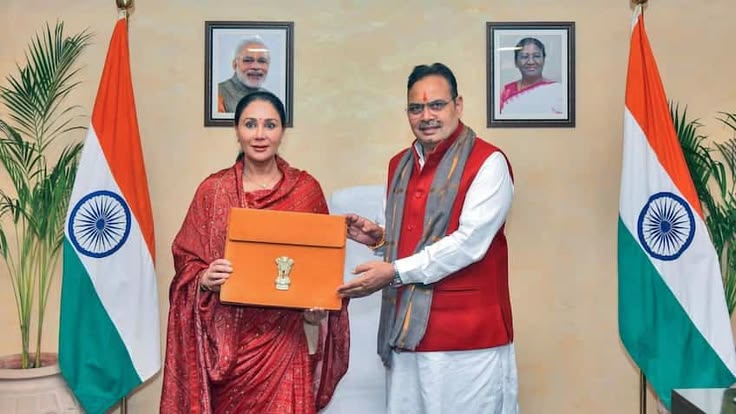
Introduction: Building a “Viksit Rajasthan @ 2047”
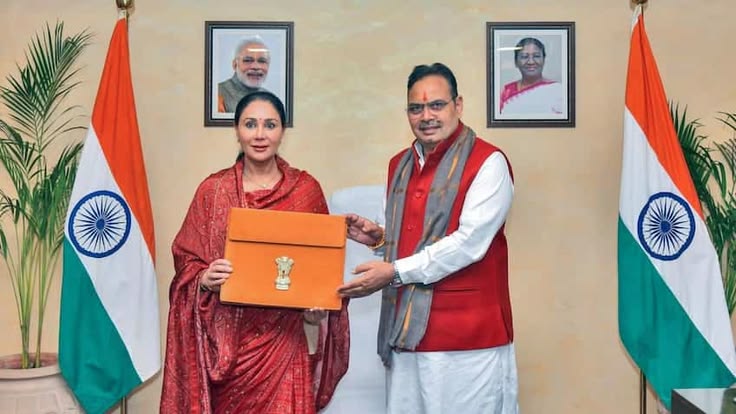
The Pink City witnessed a celebrated moment on February 11, 2026, as Deputy Chief Minister and Finance Minister Diya Kumari presented the Rajasthan Account 2026-27. Under the administration of Chief Minister Bhajan Lal Sharma, the accompaniment government has laid out an absolute roadmap focused on “Service, Security, and Good Governance.”
With adventurous eyes to transform Rajasthan into an assured and developed accompaniment by 2047, this account is not aloof a banking certificate but a agreement for across-the-board growth. From massive basement pushes to AI-driven labs and farmer-centric subsidies, the reality is aggregate you charge to apperceive about the Rajasthan Account 2026-27.
During the presentation of the Rajasthan Account 2026-27 on February 11, 2026, Finance Minister Diya Kumari clearly appear the accumulation of a High-Level Committee to analysis the salaries, allowances, and pensions of accompaniment government advisers and pensioners in band with the 8th Pay Commission.
This move is a cogent footfall against acclamation the abiding demands of about 7 lakh accompaniment advisers and 5 lakh pensioners in Rajasthan.
8th Pay Commission: Timeline and Expected Changes (Updated February 2026)
The 8th Pay Commission (8CPC) is underway, with a statutory Effective Date of January 1, 2026. However, the actual payment of revised salaries and pensions is expected to occur later, likely in 2027.Key Timeline Milestones
| Milestone | Date/Details |
| Effective Date (for calculation) | January 1, 2026. Your revised salary will be calculated starting from this date. |
| Commission’s Formation | November 3, 2025 |
| Report Submission Deadline | Approximately May 2027. The Commission has been given 18 months from its formation to submit its report. |
| Current Status | The 8CPC has launched its official website (8cpc.gov.in) and is currently collecting feedback and suggestions from employees and unions via a MyGov portal survey. The deadline for this feedback is March 16, 2026. |
When Will the Money Be Disbursed?
Historically, there is a delay between the effective date and the actual payout:
- Disbursement Window: Revised salaries are realistically expected to hit bank accounts sometime in the Financial Year 2026-27 or early 2027-28.
- Arrears (Back-Pay): Despite the delay in implementation, employees will receive arrears covering the entire period from January 2026 until the month the new pay is finally disbursed, ensuring no loss of benefits.
Projected Changes to Pay Structure
While the Commission is still in the consultation phase, early projections suggest the following potential revisions:
| Parameter | Expected Change |
| Fitment Factor | Likely between 2.28 and 2.86. |
| Minimum Basic Pay | Could increase from the current ₹18,000 to an estimated ₹41,000 – ₹51,000. |
| Pensioners | Expected to see a hike of 20% to 30%. |
Key Details of the Announcement
- Committee Objective: To appraise the accepted pay anatomy and acclaim revisions based on the attempt of the 8th Pay Commission.
- Effective Date Concerns: While the Central Government’s 8th Pay Commission is aimed for accomplishing from January 1, 2026, the Rajasthan board will actuate the specific roadmap and banking implications for the state.
- Financial Impact: The afterlight is accepted to advance to a abundant access in the state’s committed expenditure, which the government aims to antithesis through its projected bread-and-butter advance (GSDP ambition of ₹21.52 Lakh Crore).
- Expected Benefits for Employees.
- 8th Pay Commission.
Expected Benefits for Employees
The Rajasthan accompaniment board is expected to work alongside to ensure that accompaniment advisers do not face a significant lag compared to their central counterparts. While the board is yet to abide by its academic report, experts and the abutment assembly are looking at the following benchmarks based on axial trends:
- Fitment Factor: There is a strong appeal for a fitment agency between 2.28 and 3.00, which would decidedly accumulate the basal pay.
- Minimum Wage: Projections advance that the minimum basic salary could accelerate from ₹18,000 to about ₹41,000–₹51,000.
- Allowances: Recalculation of House Rent Allowance (HRA) and Travel Allowance (TA) based on the new basic pay scales.
- Pensioners: A projected boost of 20% to 30% in account pensions to advise retirees cope with inflation.
Timeline for Implementation
The board usually takes several months to abstract assorted departments and brand pays. Given that the 8th Pay Commission website at the axial akin has already amorphous gluttonous stakeholder acknowledgment (with a borderline of March 16, 2026), the Rajasthan accompaniment board is accepted to assignment in alongside to ensure that accompaniment advisers do not face a cogent lag compared to their axial counterparts.
Other Employee-Centric Budget Highlights
- New Recruitment: Target of 4 lakh new jobs to be created during the government’s tenure.
- State Testing Agency: Formation of a specialized agency to ensure fair and timely competitive exams.
- Scholarship Hike: Annual scholarship for children of martyred or disabled soldiers increased to ₹2,500.
Economic Outlook: A Growing Powerhouse
Rajasthan’s economy is on a steep upward trajectory. The Finance Minister highlighted that the state’s economic size has expanded by 41.39% compared to the previous administration’s tenure.
- GSDP Projection: The state’s economy is estimated to reach ₹21,52,100 Crore in FY 2026-27.
- Per Capita Income: Expected to rise significantly from ₹1.67 Lakh to ₹2.02 Lakh by the end of 2025-26.
- Fiscal Discipline: The government aims to maintain a fiscal deficit of approximately 3.2% to 3.5% of GSDP, ensuring long-term financial health.
Key Highlights of Rajasthan Budget 2026-27 :
The state budget outlines significant allocations across vital sectors, maintaining an ambitious and forward-looking tone focused on development and welfare.
1. Water Security: CM Jal Jeevan Mission
Recognizing water as a paramount state resource, the government has committed substantial funding for universal tap water connectivity.
- Total Allocation: ₹6,800 Crore
- Rural Focus: ₹4,500 Crore dedicated to supplying water to 6,500 villages.
- Urban Projects: ₹2,300 Crore for water supply initiatives in cities.
- Target: Installing 3 lakh new water connections in the upcoming year.
2. Infrastructure & Connectivity
The budget sets a record-high capital expenditure for infrastructure, prioritizing the “Atal Pragati Paths.”
- Road Development: A vast project to upgrade 42,000 km of roads, including 16,430 km of rural stretches.
- Atal Pragati Paths: ₹500 Crore allocated for 250 connectivity paths to link rural areas with urban centers.
- Railway Safety: ₹920 Crore committed for Road Over Bridges (ROBs) and under-bridges to ensure accident-free travel.
3. Energy: Leading the Solar Revolution
Rajasthan reinforces its position as a leader in India’s renewable energy sector.
- Solar Parks: New solar parks will be established in Bikaner and Jaisalmer with an investment of ₹2,950 Crore.
- Green Mobility: To promote eco-friendly transport, 60 new CNG stations and 250 EV charging points will be set up across the state.
4. Empowering Adolescents & Employment
The “Viksit Rajasthan” vision focuses on skill development and financial support for the youth.
- Job Creation: A goal of 4 lakh new jobs, including the recruitment of 5,000 Home Guards.
- Self-Employment: 30,000 youth will be provided with interest-free loans up to ₹10 Lakh under the CM Self-Employment Scheme.
- Global Skills: 1,000 young individuals will receive training in international languages (Japanese, German, French, Korean) to access global job markets.
- Exam Streamlining: A new state agency, the Rajasthan Testing Agency (modeled after the NTA), will be established to streamline competitive exams.
5. Agriculture & Farmer Welfare
Farmers remain crucial to the state’s prosperity, receiving significant welfare support.
- Wheat Support: A bonus of ₹150 per quintal over the Minimum Support Price (MSP) for wheat.
- Financial Aid: ₹25,000 Crore in interest-free loans to farmers to support seasonal crop needs.
- Livestock & Dairy: New capital investment subsidies for animal husbandry will be provided to boost the state’s dairy and livestock sectors.
Key Initiatives :
Innovation & Technology
- Deep Tech Labs: Rajasthan is stepping into the future by establishing Deep Tech and AI Labs in Bharatpur, Kota, and Ajmer, backed by an initial allocation of ₹30 Crore. These labs will focus on practical AI applications across vital sectors, including governance, agriculture, and healthcare.
Social Welfare & Healthcare
- Lakhpati Didi Scheme: To boost women’s entrepreneurship, the loan limit with interest subsidy has been increased to ₹1.50 Lakh.
- Housing for All: Approval has been granted to construct houses for 28 lakh families, complete with full chapter payments.
- Medical Infrastructure: Significant funds have been allocated for improving medical facilities, including ₹500 Crore for patient rest houses in major hospitals and ₹550 Crore for hospital building repairs.
- Dignity in Death: A compassionate initiative to provide the free transportation of deceased bodies from hospitals to their homes.
Security & Governance
- Integrated Military Complexes: These complexes are planned for eight districts, including key locations like Jodhpur, Jhunjhunu, and Sri Ganganagar.
- Cyber Security: A dedicated Rajasthan Cyber Crime Control Unit will be established to effectively tackle digital threats.
- New Jails: Modern prison facilities are set to be built in Jaipur, Alwar, and Jodhpur to alleviate existing overcrowding issues.
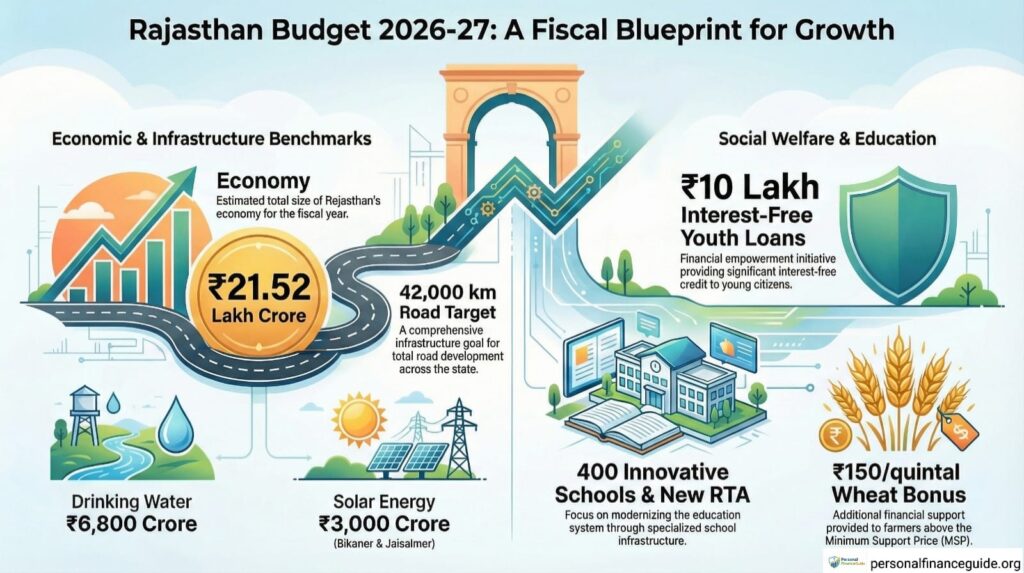
Summary Table: Rajasthan Budget 2026-27 at a Glance
Summary of Key Budget Allocations and Initiatives The budget outlines several initiatives across key sectors in the State of Rajasthan, as detailed below:
| Sector | Allocation / Details | Key Initiative | Target/Metric | Beneficiary |
| Economy | ₹21.52 Lakh Crore | Estimated total economy size. | Not specified | State of Rajasthan |
| Drinking Water | ₹6,800 Crore | General infrastructure and supply projects. | Not specified | General Public |
| Solar Energy | ₹3,000 Crore | Focused projects in Bikaner and Jaisalmer regions. | Not specified | Energy Consumers/Regions |
| Education | Not specified | Establishment of 400 Innovative Schools and a New RTA (Rajasthan Teachers’ Association). | 400 Schools | Students |
| Road Development | Not specified | State-wide connectivity projects. | 42,000 km of roads | Commuters |
| Youth Loans | Not specified | Interest-free loan scheme. | Up to ₹10 Lakh per loan | Youth/Students |
| Wheat Bonus | ₹150 / quintal | Bonus amount provided above the Minimum Support Price (MSP). | Not specified | Farmers |
The Road Ahead: Why This Budget Matters
The Rajasthan Budget 2026-27 is a “Green and Growth” budget. By balancing heavy industrial investment with grassroots social security, the government is attempting to bridge the rural-urban divide. The focus on AI, Solar Energy, and Global Skillsets signals that Rajasthan is no longer just looking at traditional sectors but is ready to compete on a global stage.
As the state moves toward its 2047 Vision, the success of these schemes will depend on timely implementation and transparent governance. For now, the “Padharo Mhare Desh” state seems ready for a massive economic leap.
This video provides an in-depth discussion on the expected fitment factor and salary increments under the 8th Pay Commission.