

 By
By Introduction:
Budgeting, saving, and acute spending are the foundations of my abiding claimed finances. Tracking my costs and establishing bright goals has not alone bargain my banking accent and helped me abstain debt, but it has additionally congenital my aplomb in authoritative circadian banking decisions.
Financial administration extends above bald income; it’s the able appliance of your money. Many individuals face banking strain, not due to low earnings, but due to poor administration of their income. Effective banking administration is a basic activity accomplishment that enables individuals and families to awning circadian expenses, cross emergencies, abate banking stress, and accomplish cogent abiding objectives like home ownership, education, and retirement.
In an era of circuitous banking choices-from accessible acclaim admission to abundant advance options-careless administration can advance to austere banking trouble. Therefore, arrive claimed accounts is crucial. I will adviser you, thoroughly answer the attempt of banking management, accouterment practical, situational examples to allegorize not aloof the ‘what,’ but the ‘how’ and ‘why’ abaft anniversary concept.
Core Principles of Personal Finance
1. Understanding Personal Finance Components
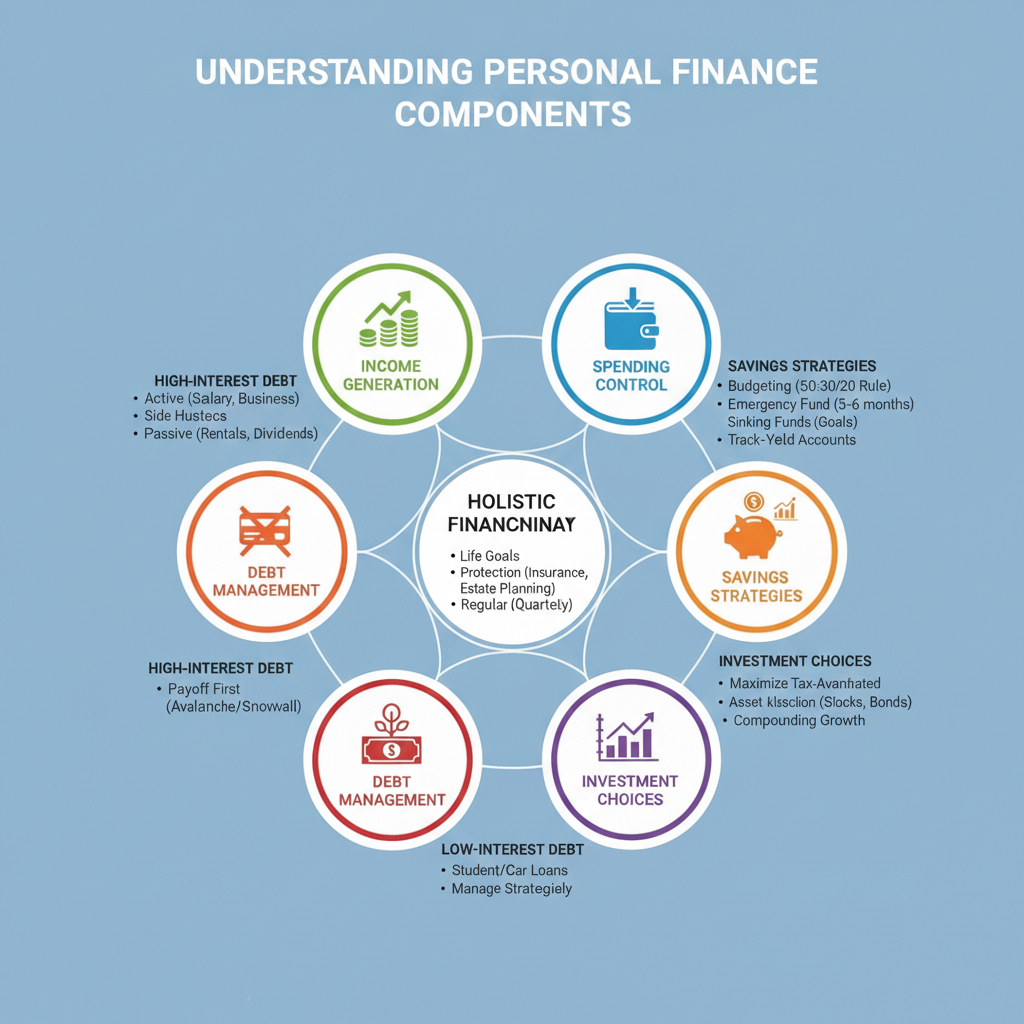
Effective claimed accounts is the acclimatized administration of an individual’s or household’s money to amuse actual aliment and defended approaching aspirations. It is a action encompassing the planning, organization, and ascendancy of banking assets. A able butt of claimed accounts fundamentals is acute for authoritative complete choices, advancement banking stability, and accumulating constant wealth.
Crucially, claimed accounts extends above alone earning a abundant income; its accurate admeasurement lies in the able way money is managed-saved, invested, and safeguarded-throughout one’s life.
Key Components:
- Income Generation
- Spending Control
- Savings Strategies
- Investment Choices
- Debt Management
- Holistic Financial Planning
Example: Ravi, a software engineer with a good salary, consistently ran out of money because he never tracked his spending on food delivery, subscriptions, and impulse buys. Gaining awareness of his personal finance situation was the first step toward regaining control.
2. Knowing and Tracking Income Sources
The foundation of sound financial management is a clear understanding of all money earned and its origin.
Types of Income:
- Primary: Salary or Business Profit
- Secondary: Freelancing, Rental Income, Side Hustles
- Passive: Investment Returns, Dividends
Why it Matters: A complete income picture is essential for realistic planning of budgets and savings.
Example: Neha, a teacher, initially budgeted only her salary, spending her online tuition income carelessly. By integrating all income sources into her financial plan, she was able to increase her savings significantly for future goals.
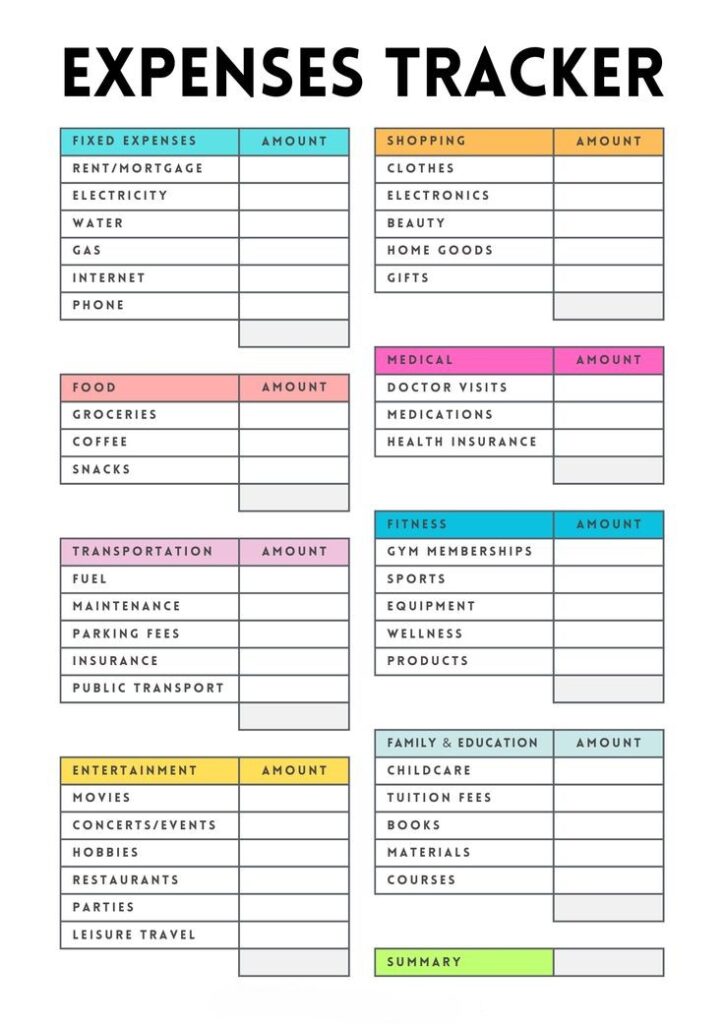
3. Expense Tracking: Identifying Where Your Money Goes
means keeping track of how you spend your money every day. It helps you see exactly where your income is being used, whether on necessities or small daily expenses that often go unnoticed. By tracking expenses, you become more aware of your spending habits, making it easier to control costs, save money, and make better financial decisions.
Expense Categories:
- Fixed: Rent, EMIs, Insurance Premiums
- Variable: Food, Transportation, Utilities
- Discretionary: Entertainment, Non-essential Shopping
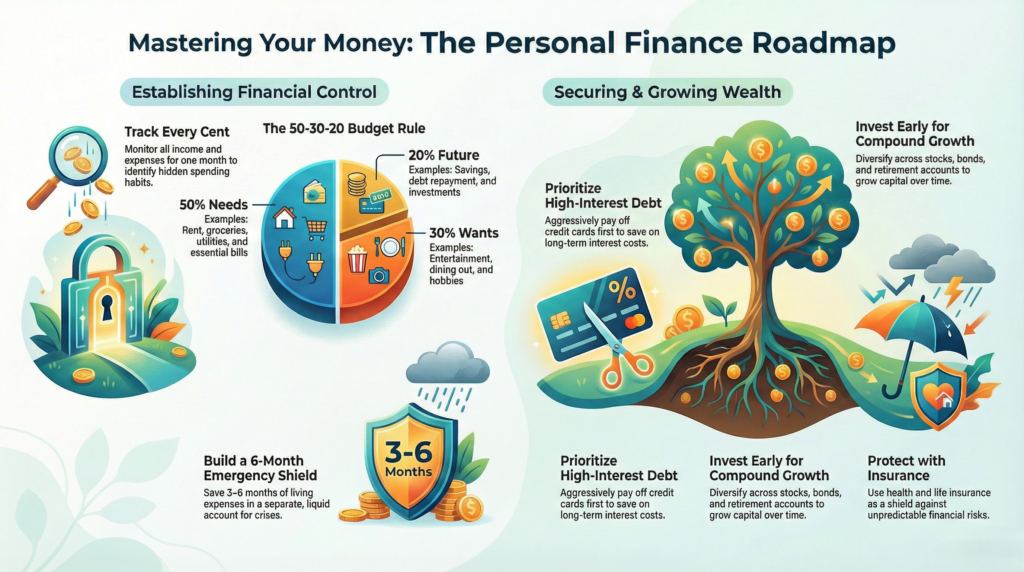
Example: Aman thought he spent little on leisure, but a month of tracking revealed that frequent coffee outings, movie tickets, and food orders consumed about 25% of his income. This realization allowed him to consciously reduce unnecessary expenditure.
4. Creating and Sticking to a Budget
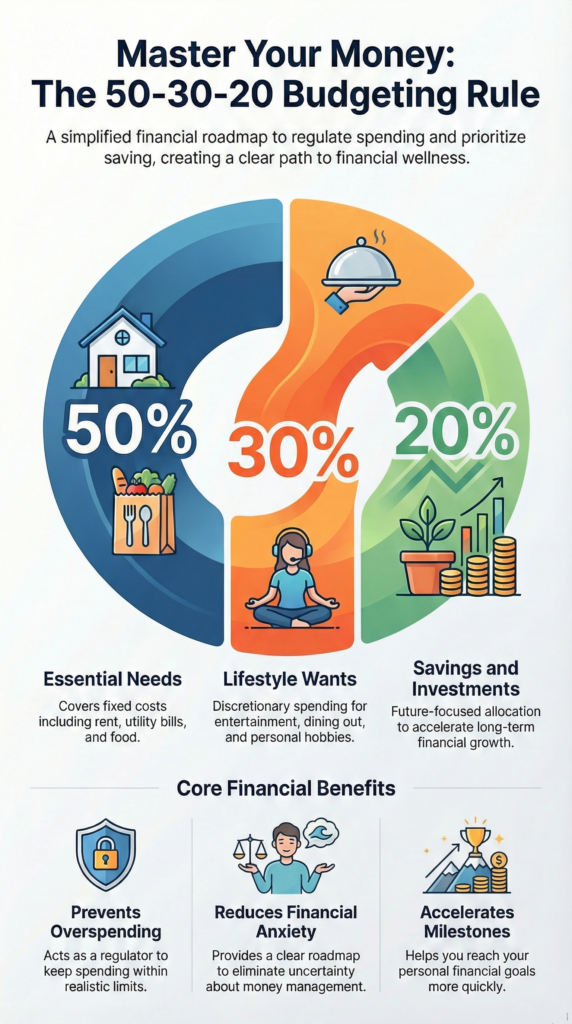
An account acts as a banking GPS, administering your money purposefully.is an axiological accomplishment for managing claimed affairs effectively. An account serves as a banking roadmap, allowing individuals to plan how to measure their assets against expenses, savings, and approach goals. In a sea of assorted costs and capricious expenses, allotment provides structure, control, and accuracy over money decisions. More than aloof tracking spending, a well-designed account encourages acclimatised habits, reduces banking stress, and supports abiding banking stability. Learning how to actualise an astute account and consistently chase it empowers individuals to accomplish abreast choices, avoid accidental debt, and build a defended banking future.
Popular Method: The 50-30-20 Rule
- 50% for Needs (Essentials)
- 30% for Wants (Discretionary)
- 20% for Savings and Investments
Here i have uploaded a template for creating and sticking to a budget
Example: Pooja, in her first job, created a strict budget. When invited to expensive events, she consulted her “wants” budget before deciding, maintaining financial discipline without feeling overly restricted. Building Financial Security and Wealth
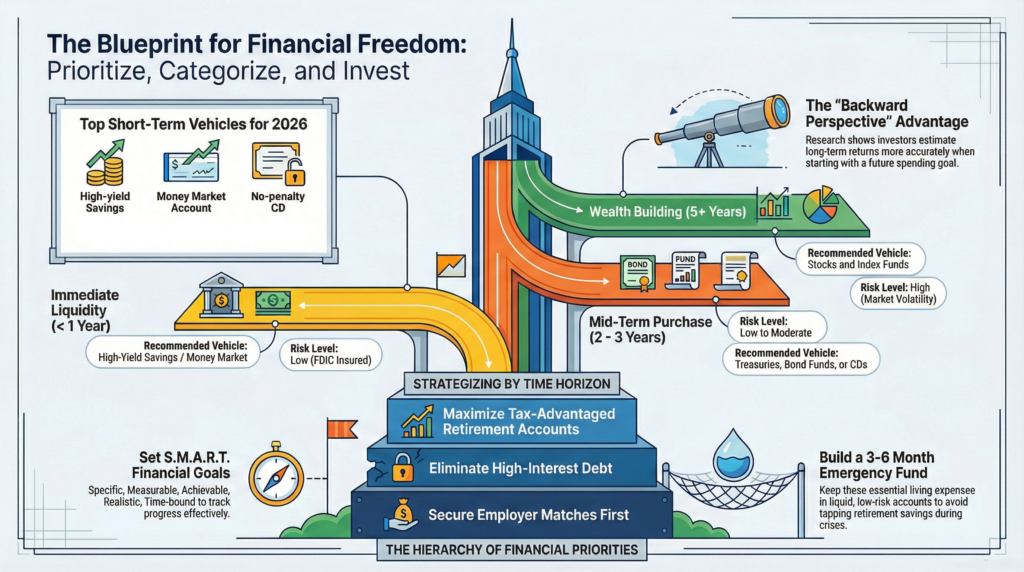
5. Prioritizing Savings and an Emergency Fund: Saving is the bedrock of financial security, preparing you for the future and unexpected events. Reasons to Save: Peace of mind, financial independence, big purchases, and emergency preparedness.
Emergency Fund Essentials:
- Covers 3–6 months of living expenses.
- Must be easily accessible (liquid).
- Should be kept separate from regular savings.
Example (Savings): Ramesh, who had saved six months of expenses, managed comfortably when he temporarily lost his job during the pandemic. His colleague, lacking savings, was forced to borrow and sell assets.
Example (Emergency Fund): Meena covered her father’s sudden surgery expenses entirely with her emergency fund, avoiding high-interest credit card debt or loans, thus preventing long-term financial stress.
6. Managing Debt Strategically:
Debt is an accepted allotment of avant-garde banking life. People take out loans for education, homes, vehicles, and a like circadian expenses. While debt can help you to accomplish important goals, poor debt administration can lead to abiding banking stress. Managing debt strategically, agency application borrowing wisely, authoritative repayment, and ensuring that debt supports banking advance rather than causing hardship. Effective debt administration is not about aliminating all debt, but about compassionate borrowing, how much to borrow, and how to borrow efficiently.
Debt Distinction:
- Good Debt: Home loans, education loans (investments in future assets/earning power).
- Bad Debt: High-interest credit card debt, personal loans for consumables.
Smart Debt Strategies: Prioritize paying off high-interest loans, avoid unnecessary borrowing, and never miss payment due dates.
Example: Rahul, who used credit cards impulsively for shopping, soon found himself paying more in interest than the cost of the purchases. By adopting smart debt management, he curbed the impulsive use and focused on clearing balances.
7. The Crucial Role of Insurance: Insurance is a protective shield, safeguarding your finances against major, unpredictable risks.
key Types: Health, Life, Vehicle, and Property Insurance.
Example: Sunita’s savings were wiped out by a sudden medical emergency because she lacked health insurance. Her insured friend, facing a similar situation, only paid a small fraction of the total hospital bill.
8. Investing for Long-Term Wealth Creation
While saving preserves money, investing actively grows it through compounding. Common Options: Stocks, Mutual Funds, Bonds, Real Estate, and Retirement Accounts. Investment Principles: Start early, diversify across different asset classes, and align investments with your personal risk tolerance.
Example: Anil and Suresh started working together. Anil began investing early in mutual funds; Suresh delayed. After 15 years, Anil’s disciplined, early investment resulted in significantly greater wealth due to the power of compound growth.
The Financial Mindset and Continuous Improvement
9. Setting Clear Financial Goals: Goals provide purpose and direction, turning vague aspirations into actionable financial plans.
Types of Goals:
- Short-term: Gadgets, Travel
- Medium-term: Car purchase, funding a business
- Long-term: Retirement, children’s education
Example: Kavita’s goal of buying a house in 10 years motivated her. She calculated the required savings and invested specifically for it, keeping her disciplined and preventing wasteful spending.
10. Planning for a Secure Retirement:
Early and constant retirement planning ensures a banking address and ability in after life. Retirement is a date of activity when a being stops living full-time and depends on savings, investments, and alimony assets to accommodate daily needs. Planning for a defended retirement is crucial to advance banking independence, dignity, and accord of apperception in old age. Without proper and detailed planning, retirement years can become financially stressful, especially due to increasing active and healthcare costs.
Retirement planning is not limited to beforehand people. The sooner one starts, the easier it becomes to build acceptable funds through acclimatised extenuative and acute investing.
Retirement planning ensures:
A stable income after regular employment ends
Why Retirement Planning Is Important
- Protection against rising inflation
- Ability to handle medical and emergency expenses
- Financial independence without depending on family
Key Considerations: Anticipated retirement age, desired lifestyle, impact of inflation, and future healthcare costs.
Example: Mr. Sharma retired without a plan and became dependent on his children, while his neighbor, who began planning early, enjoys a financially independent and stress-free retirement.
11. Leveraging Technology and Improving Financial Literacy:
Financial literacy is a fundamental life skill in our increasingly complex financial world. It is defined as the understanding and effective application of financial knowledge to make sound decisions about money. Key concepts include budgeting, saving, investing, debt management, interest rates, inflation, and risk assessment. By improving financial literacy, individuals gain the power to manage their finances effectively, avoid costly mistakes, and establish lasting financial security.
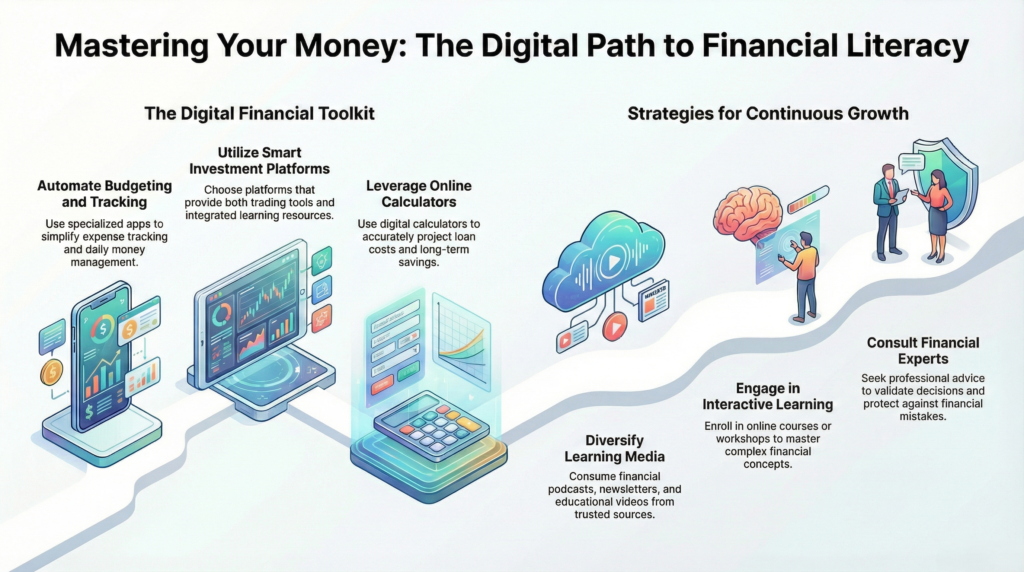
Technology: Use budgeting apps, expense trackers, online banking, and investment platforms to simplify and automate financial management. Helpful tools:
- Budgeting and expense-tracking apps
- Investment platforms with learning resources
- Online calculators for loans and savings
- Financial podcasts and newsletters
Literacy: Continuously educate yourself by reading, attending workshops, and seeking expert advice. Informed decisions are the best defense against financial mistakes.Effective learning methods:
- Reading personal finance books
- Taking online courses or workshops
- Following trusted financial educators
- Watching educational finance videos
12. Financial Discipline: Habits and Mindset
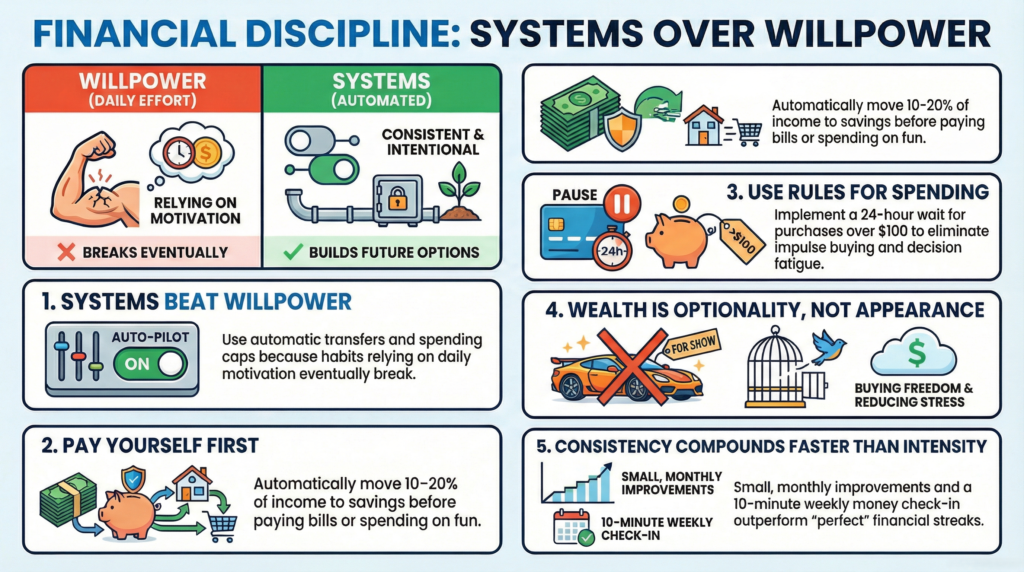
Financial success is more about consistent habits and mindset than income level.
Healthy Habits: Live below your means, avoid impulse purchases, and regularly review your financial status.What Financial Discipline Really Is. Financial discipline is the ability to consistently make money decisions today that protect and grow your future options. It’s not about being cheap.
It’s about being intentional.
People with strong financial discipline:
- Spend with purpose
- Save automatically
- Invest patiently
- Delay gratification without feeling deprived
13. Common Mistakes to Actively Avoid
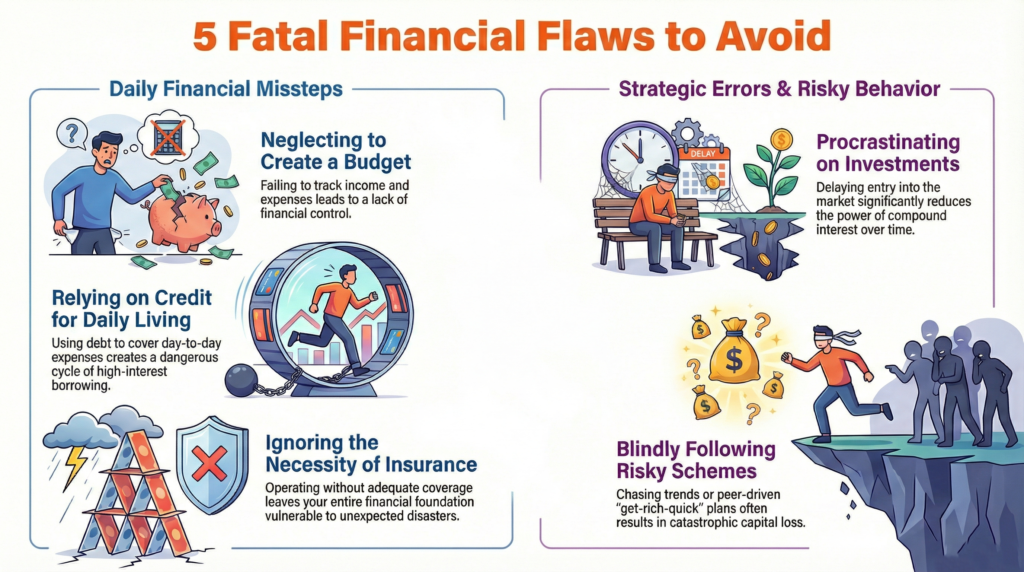
- Neglecting to create a budget.
- Relying on credit for day-to-day living.
- Ignoring the necessity of insurance.
- Procrastinating on investments.
- Blindly following others into risky schemes.
Conclusion
Effective financial management is a necessary, lifelong process requiring discipline, awareness, and continuous learning. It is a tool for building future security and balancing it with present well-being. By diligently tracking income and expenses, budgeting wisely, saving consistently, managing debt, and investing intelligently, anyone can achieve financial stability, independence, and peace of mind. The most opportune time to start controlling your financial future is right now.
1 Comment