


 By
By What Is SIP? A smart and disciplined way to build long-term wealth
Investing is not best alone for experts. Today, even beginners can alpha architecture with small amounts of money. One of the best accepted and beginner-friendly advanced methods in India is SIP. It is a “long-term advance strategy” area one can advance with as little as₹100. The record-breaking SIP arrival of ₹28,464 crore in July 2025, as reported by the Association of Mutual Funds in India (AMFI), reflects a significant about-face in how Indian retail investors access abundance creation.
This is not a number. It signals growing banking awareness, acclimatized advanced habits, and abiding thinking.
In this abundant guide, you will learn:
- What is SIP
- What is SIP investment
- What is SIP and how it works
- SIP in banking
- SIP in stock market
- What is step up SIP
- And how SIP compares with options like how to advance in gold ETFs
This commodity is absolutely structured, practical, and advised to advice you advance clearly.
What Is SIP?
SIP’s full form is Systematic Investment Plan. It is a method of investing a fixed amount regularly(monthly, weekly, daily) in mutual funds. It allows investors to build wealth gradually through disciplined monthly contributions. SIP benefits from rupee cost averaging and compounding, making it ideal for long-term financial goals like retirement, education, or wealth creation.
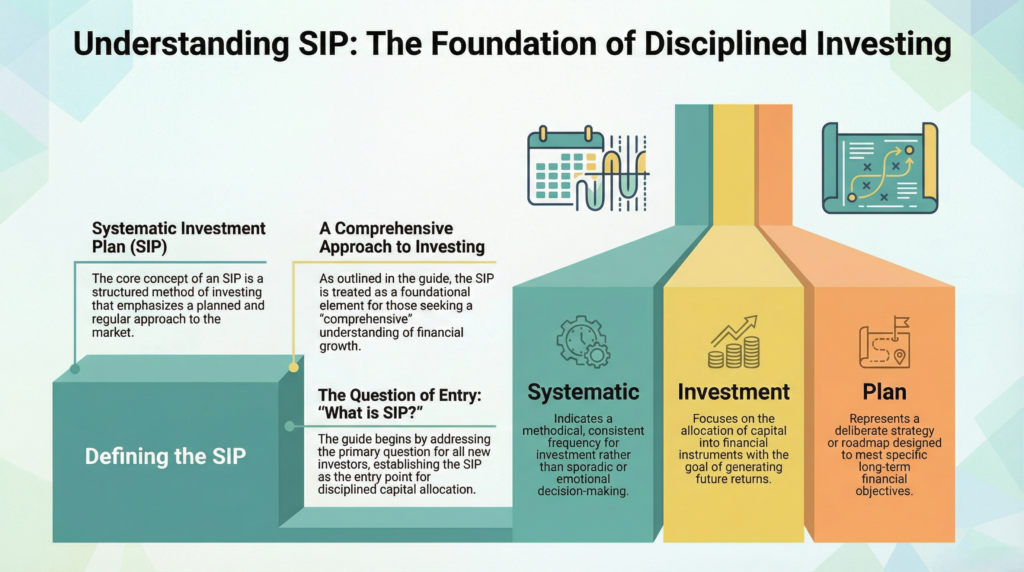
It is a method of investing a fixed amount regularly (monthly, weekly, or quarterly) in mutual funds instead of investing a lump sum.
If someone asks “what is SIP?”, the simple answer is:
SIP is a disciplined way of investing small amounts regularly to build wealth over time.
It helps investors avoid timing the market and builds financial discipline.
What Is SIP Investment?
Many beginners chase what is SIP advanced because they abash SIP with a product.
Important clarification: SIP is not an advanced product.It is an adjustment to investing.
You advance in alternate funds through SIP.
For example:
- ₹2,000 for every month in a disinterestedness alternate fund
- ₹5,000 every month in a debt alternative fund
- ₹1000 per month in SIP plan
That is an alleged SIP investment.
So, if you accept what is SIP investment, you accept that SIP is a strategy, not an asset class.
What Is SIP and How It Works
Now, let’s understand what is SIP and how it works in simple terms.
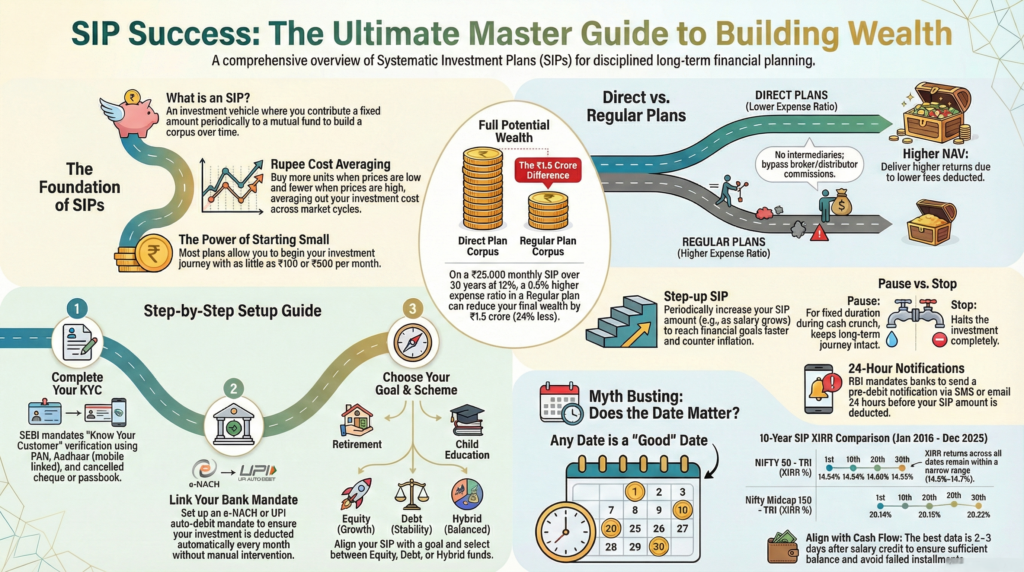
Step 1: Choose a Mutual Fund
You select a fund based on your financial goal and risk tolerance.
Step 2: Decide Investment Amount
You choose a fixed monthly amount. Decide how much you want to invest every month, week, daily its depends on you (e.g., ₹1,000 or ₹5,000).
Step 3: Set a Date
Money gets auto-debited from your bank account.
Step 4: Units Are Allocated
You receive mutual fund units based on NAV.
Step 5: Compounding Begins
Your returns generate more returns over time.
This is how SIP and how it works in real life.
Example to Understand SIP Better
Let’s say:
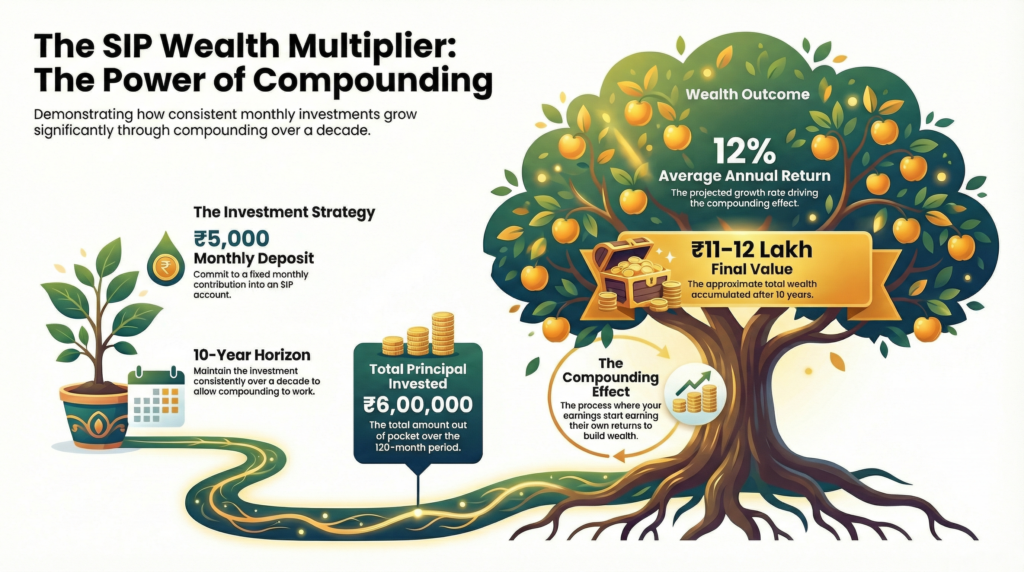
You deposit ₹5,000 monthly in SIP account for 10 years
Average return: 12% annually
Total invested amount = ₹6,00,000
Approximate amount afterwards 10 years = ₹11–12 lakh
That’s the ability of compounding.
This is why knowing what is SIP and how it works is important for abiding wealth.
SIP in Banking
Many people anticipate SIP in cyberbanking agency anchored deposits.
But SIP in cyberbanking usually refers to:
- Bank-offered alternate armamentarium SIPs
- Recurring Deposits (RD-like structure)
- Automated accumulation plans
Banks accommodate platforms area where you can easily alpha SIP.
However:
- Banks may advance approved affairs (higher commission)
- Direct alternate armamentarium platforms generally action a lower ratio
So while SIP in cyberbanking is convenient, analyse costs before investing.
SIP in Stock Market
SIP in stock market is slightly different from mutual fund SIP.
In mutual funds:
- Fund manager selects stocks.
In SIP in stock market:
- You manually buy shares every month.
Example:
- Buy ₹3,000 of Reliance every month.
- Buy ₹2,000 of TCS every month.
This builds disciplined equity investing.
However, SIP in the stock market requires more knowledge and research compared to a mutual fund SIP.
Types of SIP
Understanding the types of SIP helps you choose better.
1. Regular SIP
Fixed amount every month. In a regular SIP, a predetermined amount is invested at regular intervals for a fixed period. Perfect For: Individuals looking for disciplined investing over the long term.
Example: Mr Rahul decides to invest ₹2000 every month for one year in a mutual fund scheme. Here,
- Pre-determined amount: ₹2000
- Regular interval: monthly
- Fixed period: One year
2. Step Up SIP
Increase SIP amount annually. Step up SIP is also known as top-up SIP. In a top-up SIP or step-up SIP, the invested amount is increased periodically (e.g., on an annual basis). It allows investment to keep pace with inflation.
Perfect For: Those who can’t make a big investment initially and want to increase it according to their income. Example: Starting the investment with ₹10,000 and increasing it by 10% every year, i.e., ₹1000.
3. Flexible SIP
Change amount anytime. As the name suggests, flexible SIPs are flexible investment options. Here, the investment frequency and amount are flexible. So, the investor can increase or decrease the SIP amount based on their financial situation.
Perfect For: Individuals with irregular income or those who may face occasional cash flow constraints. Example: Investing ₹2,000 one month and ₹1,000 the next, based on fund availability.
4. Perpetual SIP
No fixed end date. In a Perpetual SIP, the amount and investment frequency are pre-defined. However, these don’t have a fixed tenure, and investors can invest as long as they want.
Perfect For: Younger generations who haven’t decided on their goals, with an investment surplus, or those who want to keep investing without worrying about the end date.
Example: Vijay invests ₹2,000 every month in a mutual fund scheme with no fixed period. The investment will continue until he decides to stop it.
Trigger SIP:
5. Trigger SIP:
The SIP installment is deducted only when a specific market event occurs (e.g., the NAV drops to a certain level or the market index hits a specific point).
What Is Step Up SIP?
What is a step-up SIP?
Step up SIP also know as top-up SIP that allows you to increase your SIP amount every year.
Example:
Year 1: ₹5,000 per month
Year 2: ₹6,000 per month
Year 3: ₹7,000 per month
This matches salary growth.
Step up SIP significantly increases long-term wealth compared to a fixed SIP.
If your salary grows 8–10% yearly, stepping up SIP is a smart strategy.
Benefits of SIP
Understanding what is SIP is incomplete without the benefits.
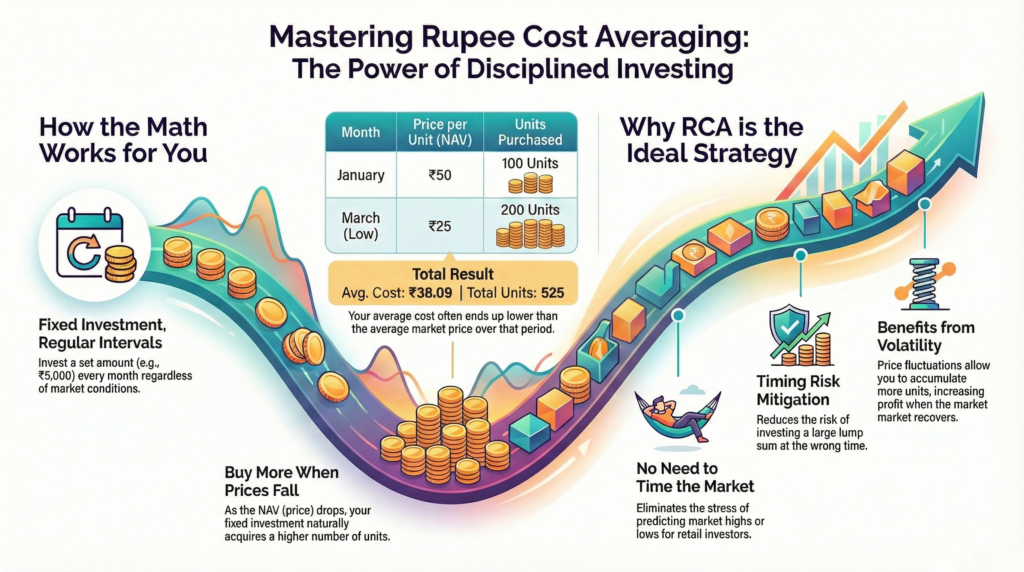
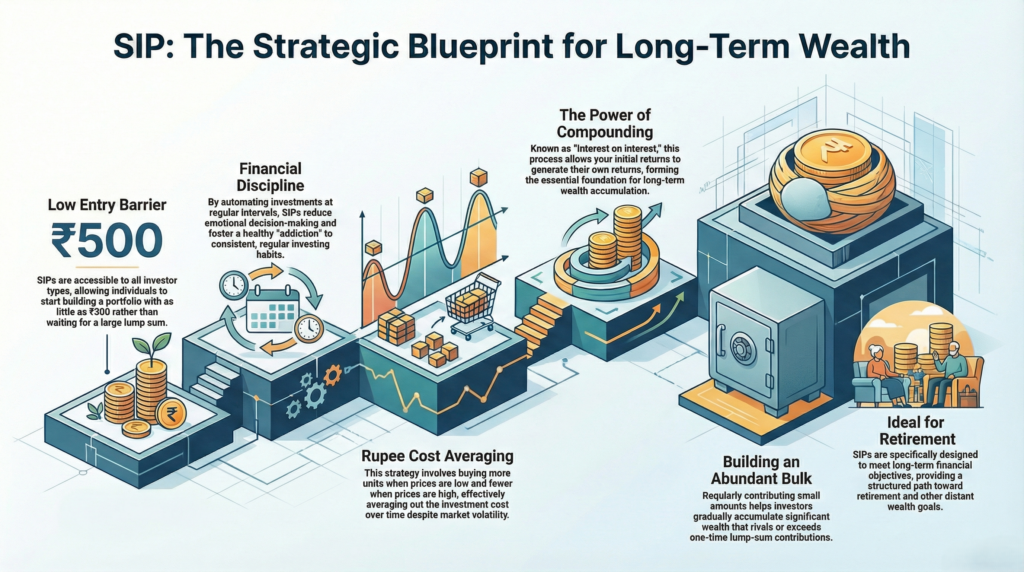
1. Rupee Cost Averaging
You buy more units when the price is low. When investors invest regularly over time, irrespective of market volatility, the overall cost of investments is averaged out. This way, when the market is down, more mutual fund units will be allocated and fewer units when markets are up.
2. Power of Compounding
Returns generate more returns. The power of compounding is the process where your money earns returns, and those returns start earning their own returns. In simple words: You earn interest on your interest. This is the foundation of long-term wealth creation.
3. Low Entry Barrier
Start with ₹500.SIP advance is absolute for all types of investors, including those with bound funds. You don’t charge a large sum of money; like baby account contributions can accumulate decidedly over time.
4. Discipline
Automatic investing reduces emotional decisions.SIPs animate investors to advance an anchored bulk at approved intervals. This way, one can derive several benefits, like an addiction to constant and acclimatized investing
Regularly advancing baby amounts helps gradually build an abundant bulk after a lump-sum contribution.
5. Long-Term Wealth Creation
Ideal for retirement and long-term goals.
SIP vs Lump Sum Investment
For beginners learning what is SIP, starting with SIP is usually safer.
SIP vs. Lump Sum Investment: A Comparison
| Feature | SIP (Systematic Investment Plan) | Lump Sum |
| Risk Profile | Lower | Higher |
| Timing | No timing expertise required | Requires market timing |
| Ideal For | Salaried investors | Investors with significant capital |
Recommendation for Beginners:
For those new to investing and learning about SIPs, starting with a SIP is generally considered the safer approach.
SIP vs Gold ETF
Many investors compare SIP with gold investment options.
If you are wondering how to invest in a gold ETF, understand this:
Gold ETF:
- Invest in gold digitally
- Traded on the stock exchange
- Good for diversification
SIP:
- Method to invest in mutual funds
- Can invest in equity, debt, and gold funds
Interestingly, you can even do SIP in Gold ETF through Gold mutual funds.
So learning how to invest in gold ETF and understanding what is SIP both help in portfolio diversification.
How To Invest in SIP
Step-by-step:
- Complete KYC
- Choose a mutual fund
- Decide SIP amount
- Select date
- Set auto-debit mandate
Platforms:
- AMC website
- Direct mutual fund platforms
- Broker apps
- Banks
Minimum SIP Amount
You can start with:
₹500 per month (most funds)
That makes what is SIP investment accessible to everyone.
Who Should Start SIP?
- Salaried professionals
- Young investors
- Parents planning child’s education
- Retirement planners
- Beginners
If you are 25–35 years old, SIP can be your best wealth creation tool.
How Long Should You Continue SIP?
Ideal duration:
- 5+ years for equity SIP
- 10+ years for major wealth creation
- 15+ years for retirement
The longer you continue, the more compounding works.
Mistakes to Avoid in SIP
- Stopping during market crash
- Checking daily NAV
- Investing without goal
- Choosing funds randomly
- Ignoring asset allocation
Key Considerations for SIP Investing
Here are some important factors to remember before starting a Systematic Investment Plan (SIP):
1. Exit Load: An Exit Load is a fee charged when you withdraw your investment (redeem mutual fund units) before a specified minimum holding period, which is typically 1 to 3 years. This charge generally starts at 1% and varies depending on the specific mutual fund chosen.
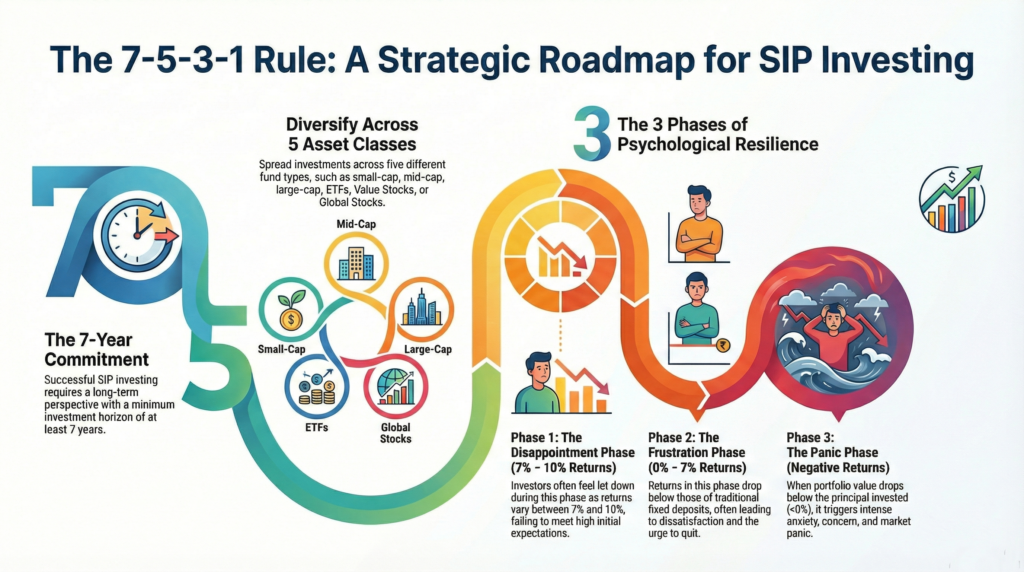
2. The 7-5-3-1 SIP Investing Rule for Optimal Returns: Follow this rule to potentially achieve better long-term returns:
- 7 (Years): Commit to investing for a minimum duration of 7 years.
- 5 (Funds/Asset Classes): Diversify your investment by spreading the amount across five different funds or asset classes. Examples include small-cap, mid-cap, large-cap, ETFs, Value Stocks, and Global Stocks.
- 3 (Phases): Be prepared to face the three psychological phases that often tempt investors to stop their SIP:
- The Disappointment Phase: Returns are moderate (7%–10%). Investors may feel disappointed if they expected higher returns.
- The Irritation Phase: Returns drop below those of fixed deposits (0%–7%), leading to frustration.
- The Panic Phase: The portfolio value becomes negative (less than 0% return), triggering anxiety and panic.
- 1 (Increase): Increase your SIP contribution amount at least once a year.
Taxation of SIP
Depends on fund type.
Equity Funds:
Short-term (<1 year): 15%
Long-term (>1 year): 10% above ₹1 lakh gains
Debt Funds:
Taxed as per slab (new rules apply)
Is SIP Safe?
SIP reduces risk but does not eliminate market risk.
If invested in equity funds:
Returns depend on market performance.
SIP is safer than lump sum, but not risk-free.
Can You Pause or Stop SIP?
Yes. You can:
- Pause temporarily
- Increase amount
- Decrease amount
- Stop anytime
Flexibility is one major benefit.
SIP for Different Goals
Retirement
Long-term equity SIP
Child Education
Hybrid funds
Emergency Fund
Debt SIP
Wealth Growth
Large-cap + mid-cap funds
Combining SIP and Gold ETF
Smart investors diversify.
Portfolio example:
- 60% Equity SIP
- 20% Debt SIP
- 20% Gold ETF
If you are learning how to invest in gold ETF, combine it with SIP strategy for balanced investing.
Power of Early SIP
Investor A:
Starts at 25 years
₹5,000 per month for 20 years
Investor B:
Starts at 35 years
₹5,000 per month for 10 years
Investor A builds almost double wealth.
Time matters more than amount.

SIP in Bear Market
Best time to continue SIP.
Why?
You buy more units at lower price.
When market recovers, returns accelerate.
Frequently Asked Questions
What is SIP investment?
It is investing regularly in mutual funds through a fixed monthly amount.
What is SIP and how it works?
Money gets auto-debited and invested in mutual funds regularly.
What is step up SIP?
A SIP where investment amount increases yearly.
What is SIP in stock market?
Buying shares systematically every month.
What is SIP in banking?
Bank-facilitated mutual fund investment plans.
Final Thoughts
Understanding what is SIP is the first step toward financial freedom. It is:
- Simple
- Disciplined
- Powerful
- Beginner-friendly
If combined with diversification tools like learning how to invest in gold ETF, you create a strong and balanced portfolio.
Wealth is not built overnight.
It is built through:
Consistency + Discipline to Start small. Start today. Let compounding do the rest.